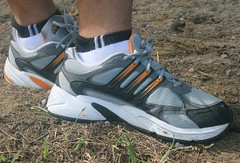
Just came back from FZ. I did a 5K run in 34 minutes 15 seconds followed by a 30 minutes individual spinning. Talking about spinning, the final of the spinning marathon will be held sometime June. 12 gym members out of 50, qualified to the final round and I am one of them. Not sure if I can make it during the final. Just hope it will not clash with my June O and A level examination invigilation.
Showing posts with label FITNESS. Show all posts
Showing posts with label FITNESS. Show all posts
Thursday, May 15, 2008
Friday, March 14, 2008

Monday, February 18, 2008
WHAT MAKES SPINNING CLASS DIFFERENT FROM OTHER GROUP EXERCISE CLASSES?
Top-notch instructors, invigorating music and visualization come together to make Spinning class both fun and effective. If you've ever left a group exercise class feeling frustrated, you'll appreciate that there are no complicated moves to learn with the Spinning program. Regardless of how fit, flexible or coordinated you are, you'll get a great workout. Simply hop on your bike, set the resistance to the level that's right for you, and let your instructor guide you through an incredible ride.
Sunday, February 17, 2008
MYTH: CYCLING (SPINNING) = BULKY LEGS

Something to share with readers:
The "climbs" that are incorporated into a Spinning class simulate the experience of riding up a hill. Climbing is an excellent way to build strength, which means you not only get shapelier legs but also stoke your metabolism since muscle needs more calories to sustain itself than fat does. However, most climbs only last a few minutes, which is not enough time to build big, bulky leg and butt muscles.
Another benefit: Helps you run better and alleviates back-pain.
Friday, January 18, 2008
SECOND OUTDOOR CYCLING
Started from Bukit Shahbandar (at around 7am) I cycled along the Jerudong highway towards Muara. From Muara I returned back to Bukit Shahbandar. The journey took me about an hour (I still can't find time to get myself a speedometer..... may be tomorrow... if time permits). Generally it was an easy ride because I did not have to encounter bumpy roads.
On other matter, I went to FZ yesterday with a very high hope to do an intense spin. I was so disappointed because there was a change in timetable again. The 5.30pm class which was supposed to be instructed by HEP was now done by ROSE. But to make my journey worth my while I spinned anyway..... Generally it was a very light spin..... (Not at all to my liking)....
Yesterday was the first CCA session for MS. Since only four students registered for Cycling club, the club has to be dissolved because one teacher has to be in-charged of at least 15 students. So next week I will be put in-charged (along with James) of the Fitness Club.
Thursday, November 1, 2007
FITNESS ZONE
Yesterday, I went to Fitness Zone to enroll myself as a member for 6 months. Yesterday was actually (luckily) the last day of a special promotion, so I was entitled to 90% off of the lifetime membership fee. So instead of paying the normal $500, I only have to pay $50.
To start with, I joined the group cycling class for a duration of full 2 hours. It was something new and fun. If I am committed enough to do the group cycling consistently for 5 times a week, I am sure I can burn all the EXCESS BAGGAGE that I recently gained during the recent festive season.
To start with, I joined the group cycling class for a duration of full 2 hours. It was something new and fun. If I am committed enough to do the group cycling consistently for 5 times a week, I am sure I can burn all the EXCESS BAGGAGE that I recently gained during the recent festive season.
Friday, March 16, 2007
DEHYDRATION
Water is the essence of life. It is the most important nutrient in our bodies, making up roughly 70 percent of our muscle and brain tissue. Only oxygen is craved by the body more than water.
Unfortunately, most people do not consume sufficient water every day to meet their bodies' most basic requirements, leaving them dehydrated. Dehydration itself is responsible for a wide range of common ailments experienced by just about everyone in today's busy, fast-paced world, including headache and fatigue.
When we breathe, we lose moisture to the air every time we exhale - as much as two cups a day! Furthermore, our bodies lose water through evaporation from the surface of our skin even without rigorous exercise, and of course we also pass water in our urine. During the course of an average day, a healthy adult can lose eight to 10 cups of water. Add in exercise, and this number rises considerably.
If we fail to replenish the water we lose through these natural processes, we set off a physiological reaction that can have serious health effects. The following is the natural progression of dehydration and its effects on the body (symptoms):
Mild
- because your kidneys will begin to conserve water, your urine will become concentrated and will be amber colored as opposed to a normal light-tinted yellow color.
- constipation and/or bloating may be noticed
- dry skin, mucous membranes, and lips
- thirst, often extreme
- flushed face
- fatigue
- sunken eyes or sunken fontanels (soft spot on head) in infants
- lack of tears in crying infant
- "doughy" skin that doesn't bounce back when pinched
- dizziness / vertigo / lightheadedness
- up to 30% decline in physical labor capacity, muscle cramping
- headache
- cold hands and feet
- problems concentrating
- drowsiness
- fainting
- impatience and extreme irritability
- major reduction in urine production
- weak irregular heart beat (often racing) and low blood pressure
- rapid breathing
- failure of body's heat regulation systems (sweating, for example)
- confusion
- vomiting and/or diarrhea
- shock, collapse or unconsciousness
- seizures
- coma and death
To prevent dehydration, experts recommend that everyone drink at least six to eight glasses of water a day.
According to nutritionists, the best way to fight the heat and the cold is to drink plenty of water.
Keeping Cool in the Heat
- Add two glasses a day to your 8-glass minimum. Also, keep in mind that heavy perspiration from physical activity can result in the loss of 12, 14 or even 16 glasses of water per day!
- Drink before you get thirsty. If you wait until you're thirsty, you're already slightly dehydrated. Thirst is an unreliable indicator of your hydration needs.
- Reduce your physical activity level if it is overly hot.
- Monitor infants, children, and the elderly. In addition to being more susceptible to dehydration, they are also often unable to express their thirst or to hydrate themselves.
- Pregnant women need to drink more water. They need to accommodate the needs of the fetus and the fluid losses due to increased heat production and perspiration. Lactating women need to increase water intake to replace fluid lost through nursing.
- Don't count beverages containing caffeine or alcohol toward your 8 glasses! Caffeine and alcohol dehydrate your body, so you need to compensate for them. Drink an extra glass of water for each cup of regular coffee or tea, and for each glass of an alcoholic beverage that you drink.
Friday, February 23, 2007
GUYS... WHICH ONE ARE YOU?
Guys out there, which one are you? OK OK to be fair, let me be the one to be the first to answer my own question. I am currently the third one from the left. My quest is at least to be the second one on the left. No offence guys. Just a a little guideline and a gentle reminder for us to lead a healthy life.
FOR THE LADIES... WHICH ONE ARE YOU?
No offence OK. Just like to share. Hopefully this can be considered as a WAKE UP CALL for those who are out of shape. My wife's BMI is currently around 25 and now (commencing this morning) she is on her MISSION to shed that extra 5kg.
Friday, February 16, 2007
MAKTAB SAINS FITNESS CLUB
The following pics were taken on the 15th February during the CCA session at JPMC gym:


Wednesday, February 14, 2007
GUIDELINES FOR SELECTING YOUR HEART RATE EXERCISE ZONE
There are five basic heart rate exercise zones. Simply select a zone that is the fitness goal you want to achieve during a particular exercise. When you begin your exercise, always start at a lower zone and allow your body to warm up and prepare to work in your target exercise zone. For example, you can "warm up" in the Light Exercise zone, spend the majority of your exercise in the Weight Management zone, and then spend a bit of time in the Aerobic Base Building zone. The intensity of Zones 4 and 5 is demanding enough that exercise in these zones should be done for limited intervals of a workout and with the guidance of qualified medical or coaching professional.

For example, if you want to Lose Weight/Burn Fat: do your favorite exercise at 60%-70% of your maximum heart rate, based on your age, for at least 30 minutes a day, three times a week. To program your Timex Digital Heart Rate Monitor to put you in your Ideal Weight Management Zone, use the Target Heart Rate Zone Chart.
Select which level of condition represents your current physical condition and locate the Lower and Upper Heart Rate Zones for your age from the Target Heart Rate Zone Chart. See Operating the Digital Sportswatch to program your Lower and Upper Heart Rate Zone into your Timex Digital Heart Rate Monitor.

The latest findings on fitness show anyone at any age can get fit/stay fit without being fanatic. For the "moderate" exerciser, staying fit can be as simple as:
* Exercise 3 Times a Week
* Exercise 30-45 Minutes Each Time
* Exercise in Your Appropriate Target Heart Rate Zone
Thursday, February 1, 2007
FITNESS CLUB
Thursday is CCA day for Maktab Sains. Me and three other teachers are put in-charge of the school's FITNESS CLUB which comprises of about 40 boys and girls (imgine having them all in the JPMC gym!). So members of the JPMC gym, please avoid Thursday mornings otherwise you will be frustrated waiting for the students to finish using your favourite machine.
As in the previous weeks, while the students were busy doing their exercises, we teachers were also busy with our workouts. Today I only managed to run 8K on the treadmill (Speed = 9.5kmph to 10.2kmph, Time = 49mins 32secs)
Friday, January 26, 2007
ACHILLES TENDON
 |  A rupture to the Achilles tendon is a very common injury in male athletes
Who? Most common for
How? tissue at the end of a muscle which attaches it to a bone. The Achilles tendon is what attaches your calf muscles to your heel. What kind of pain? Treatment? Recovery? |
Subscribe to:
Posts (Atom)